.png)



Training







Services








Train managers for difficult conversations with repeated AI roleplay practice and a feedback loop — build the reflex that classroom training can't.

To train managers for difficult conversations, give them repeated, low-stakes practice with AI roleplay partners that react with real emotion, then debrief each attempt against a clear set of criteria for what a good conversation looks like.
Classroom sessions and peer roleplays often fall short because the training focuses on improving knowledge more than it does application. Building a learner's conversational reflex only comes from practice.
A manager can run 20 practice conversations with an AI roleplay platform in the time a workshop delivers one. Which is one of the reasons why more L&D teams are focusing on the application of training more in 2026 — particularly then it comes to building employees' conversational skills.
Most programs teach managers about hard conversations without ever letting them have one. A half-day workshop covers the theory (stay calm, lead with facts, listen actively) and then sends people back to their desks. The first time they actually deliver tough feedback or manage a layoff, they focus on trying to remember their training, because their muscle memory for tough conversations isn't there.
Difficult conversations are a performance skill, not a memory or knowledge skill. Knowing the steps to defuse a defensive employee is very different from staying composed when one is sitting across from you, arms crossed, getting louder. Under pressure, managers fall back on habit: they soften the message until it disappears, talk over the silence, or avoid the conversation entirely.
Peer roleplay is meant to bridge that gap, but it rarely does.
At its worst, peer roleplay feel awkward and not true to life, while feedback can be friendly rather than honest. At its best, peer roleplay is difficult to schedule in a busy workplace, so either falls by the wayside or is delivered inconsistently — too inconsistently to help learners build real muscle memory.
But let's look at proven ways to improve that, by effectively training managers and leaders for their most challenging conversations.
Before any practice happens, decide what a well-handled conversation actually involves. Spell it out as a short, concrete set of criteria: did the manager open by naming the specific situation, describe observable behavior instead of throwing out judgments, explain the real impact, and then move toward a solution together?
The exact criteria are yours to set. Many teams adapt an established model, like an SBI (situation, behavior, impact) framework; others build their own "company way" of having these conversations. What matters is that the standard is specific and consistent, so every manager is practicing against the same definition of good rather than winging it.
Clear criteria also reinforce the soft skills that define strong leadership — clarity, empathy, and composure under pressure.
A lecture or a slide deck builds awareness; but awareness isn't competence. Managers need to rehearse the actual conversation, out loud, in real time, with someone pushing back.
Classroom roleplay tries to do this, but (as we've mentioned) it depends on a willing partner, a trainer's schedule, and a room full of people watching. It doesn't scale across a distributed team, and the discomfort of performing in front of peers means people hold back — one of the reasons AI roleplay outperforms peer roleplay for building real skill.
To build skill, practice has to be private, repeatable, and available whenever the manager has ten minutes. In 2026, there's a whole technology sector built to help you here, so you're not always relying on pure people power.
Once you know you want practice, the next decision is which kind of AI roleplay fits the conversation you're training for. The deciding factor is realism: the practice has to mirror how the real conversation actually happens.
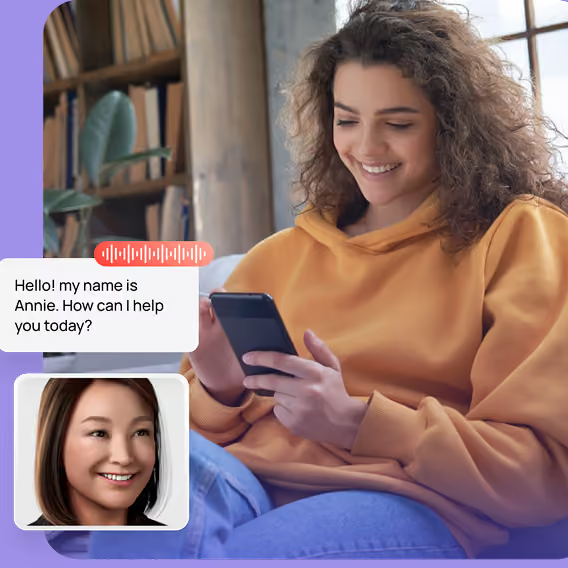
If the real exchange lives on the phone (cold outreach, a sales call, a contact-center script) then voice roleplay is a sensible match, because tone of voice carries most of the signal and there's no face to read anyway.
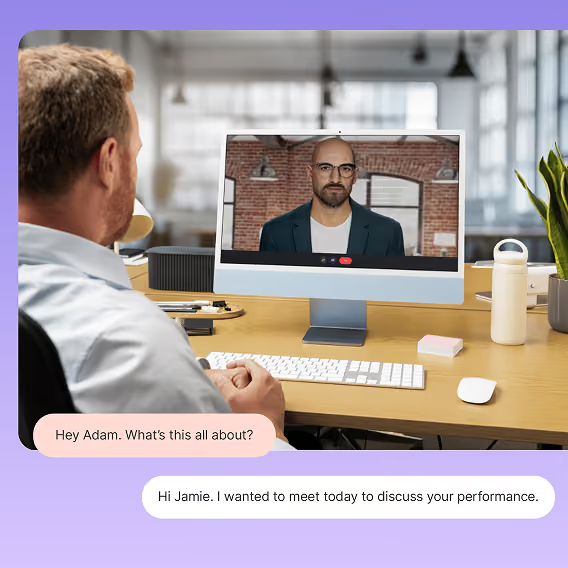
But other difficult conversations don't happen down a phone line. A performance review, a termination, mediating a clash between two reports — these are in-person, high-emotion moments where the hardest part is holding steady while you watch someone's expression change in front of you.
There are many other factors, like how customizable a roleplay tool might be for your own criteria. For the best ROI, choose the right roleplay tool for your organization and your team.
Practice without feedback just reinforces bad habits. After each conversation, managers need to see what worked and what didn't, measured against the criteria you defined up front:
This is where the criteria and the platform do different jobs. You decide what makes a roleplay scenario a success; the platform then scores each attempt against it, points to one or two specific things to fix next time, then allows the manager to jump back in to try again.
The loop (practice, feedback, adjust, repeat) is what converts a definition on paper into a skill in the body.
A completion certificate tells you a manager showed up. It says nothing about whether they can actually deliver hard feedback.
Great roleplay platforms will help you see when a manager is ready for the real conversation, and who needs more coaching (either through the platform or with more direct one-on-one mentorship). For instance, UneeQ's Immersive Training Platform includes an endorsement feature to show when a learner has exceeded your criteria and succeeded at the training.
Both build awareness. Only one builds the reflex managers need when a difficult conversation gets real.
| What matters | AI roleplay (face-to-face) | Classroom & peer roleplay |
|---|---|---|
| Repetitions | Unlimited — 20 in the time a workshop gives one | Usually one attempt per session |
| Emotional realism | Real facial expression and tone | Awkward, low emotional pressure |
| Psychological safety | Private and judgment-free | Performed in front of colleagues |
| Feedback | Instant, specific scoring | Friendly and general |
| Consistency | Same quality for every manager | Varies by trainer and partner |
| Availability | On demand, anytime | Scheduled, often quarterly |
| Measures | Behavior change over time | Attendance and completion |
| Best for | Building reflex before it counts | Introducing the theory |
The harder the conversation, the more the human signals matter. Tone, eye contact, a pause, a flicker of frustration on someone's face — these are the cues a manager has to read and respond to in real time.
Face-to-face practice with emotionally intelligent digital humans closes that gap. When the AI character's expression shifts as you deliver bad news, the manager feels something close to the real thing, and learns to hold steady through it. That's the difference between rehearsing a line in a script and simulating a moment.
Adoption is moving fast in this direction. According to Allego's 2025 AI in Revenue Enablement Report, 43% of enablement leaders now use AI-powered roleplay to sharpen coaching. And LinkedIn Learning's 2025 Workplace Learning Report found 71% of L&D professionals are exploring, experimenting with, or integrating AI into their work.
Immersive practice is becoming the default way to build skills that only stick when people actually do them, which is why platforms like the UneeQ Immersive Training Platform are built around realistic, repeatable roleplay rather than passive content. It's the same approach behind UneeQ's leadership training, where managers rehearse the hard managerial moments before they happen — and you can dig deeper into the wider shift in our take on why great leaders love learning.
A difficult conversation is any high-stakes exchange where emotions run high and the outcome matters — delivering critical performance feedback, managing a conflict between team members, denying a promotion, or letting someone go. What makes these conversations hard isn’t the information; it’s the emotional pressure and the risk of damaging a relationship or a person’s confidence. Managers face them regularly, and handling them poorly drives disengagement and turnover.
Most programs teach the theory of difficult conversations but never give managers enough real practice. A one-off workshop builds awareness, then sends people back to their jobs to face the real thing cold. Because difficult conversations are a performance skill built on reflex, not a knowledge skill, managers freeze under pressure and fall back on old habits — avoiding, softening, or over-talking — no matter how good the slides were.
AI roleplay gives managers a private, judgment-free partner to rehearse hard conversations as many times as they need. The AI character reacts with realistic emotion and can respond differently each run, so managers learn to adapt in the moment rather than memorize a script. Face-to-face digital humans add facial expression and tone, training managers to read and respond to the human cues that matter most when stakes are high.
Measure behavior change, not course completion. Track whether managers are initiating tough conversations sooner instead of avoiding them, whether their direct reports report clearer and fairer feedback, and whether practice scores improve over time on specifics like clarity, empathy, and composure. Completion rates tell you someone attended; behavioral signals and improving practice performance tell you the training actually changed how they manage.
Voice AI roleplay simulates a spoken conversation with no visual presence — you hear a voice but see no face, which suits phone-based practice like cold calls or contact-center scripts. Immersive AI roleplay puts a lifelike digital human in front of you, adding facial expression, body language, and emotional cues. For in-person, high-emotion conversations like performance reviews or terminations, immersive roleplay is the realistic match.