.png)



Training





Services









Virti alternatives for AI roleplay and immersive learning: see how UneeQ, Tavus, and Yoodli compare on realism, analytics, and price — and which fits.

Virti is a training platform that pairs AI roleplay with interactive video across desktop, mobile, and VR. The best alternative depends on the training job you're solving. For the highest-fidelity, face-to-face roleplay with deep soft-skills analytics and enterprise deployment, UneeQ's Immersive Training Platform is the closest match. For developer teams building custom, photorealistic conversational video from APIs, Tavus fits. For coaching individuals on speaking and presentation skills, Yoodli is a strong, affordable pick. Match the tool to the outcome: realistic, measurable face-to-face practice, a build-your-own toolkit, or personal communication coaching.
So you're weighing up Virti and wondering what alternatives are out there. Smart move. Virti has built a genuinely useful platform that's quick to set up and available on lots of devices. It scales from a small team on an entry plan all the way up to a full enterprise rollout, and its reviews are strong. Plenty of teams love it, and we'll happily say so.
But "does a bit of everything" and "does the one thing you need brilliantly" aren't always the same platform. Someone shopping around Virti is usually chasing one of three very different things: sharper realism, more control, or a lighter tool for one person at a time. So this guide does two things.
First, it sorts the options by the job you're hiring the tool to do — because picking the wrong job is the most expensive mistake you can make. Then it breaks down the three alternatives worth knowing: UneeQ, Tavus, and Yoodli. We'll keep the claims grounded, we'll cite our sources, and we'll tell you plainly when one of these tools is great at something we're not.
Please keep in mind, this guide was written in 2026, and uses publicly accessible information to make assessments that are as accurate as possible at the time of writing.
We've been building digital humans for a decade. Here's what we think you should know about Virti and some of the best alternative vendors out there.

Virti is an AI roleplay and immersive video training platform. It started life in healthcare simulation — think clinical scenarios and first-responder drills — and has since gone horizontal into corporate, government, and education. The core pitch is accessibility: build a scenario with no code in a few minutes, then deliver it on desktop, mobile, or a VR headset.
Here's where Virti genuinely earns its spot.
It really does do a bit of everything. Virti spans 2D video, 360° video, VR headsets, and AI roleplay in one platform, covering both hard skills (procedures, safety, hazard-spotting) and soft skills (difficult conversations, customer service). That breadth is a real strength, and it shows up in Virti's customer base, which skews toward hands-on, high-stakes simulation — healthcare systems, clinical schools, and emergency-response organizations. When the training job is "walk through a risky physical procedure in a headset," VR immersion pays off, and that's Virti's home turf.
It's fast and code-free. Virti's editor and templates let trainers spin up a scenario quickly. Reviewers consistently call it intuitive and easy to use, and praise how fast they can get practice in front of learners (Virti/G2, 2026).
It scales down as well as up. Virti's published pricing runs from around $399/month for an entry plan up to higher tiers near $1,199/month, with enterprise on custom quotes (Virti/G2, 2026). That's a genuinely useful point of difference: Virti reaches smaller teams that enterprise-only platforms simply don't serve. At the top end, though, it's a full training platform priced in the same ballpark as dedicated enterprise tools — so "cheap" isn't quite the right word once you're rolling it out at scale.
Virti is well-liked, but no tool is perfect. Here's where buyers, reviewers, and Virti itself say it comes up short.
Avatar realism is the soft spot. This is the big one for anyone whose training hinges on emotionally believable conversations. In its own early-2026 update, Virti was candid that some users find the voices robotic, that accent diversity is limited, and that avatars can drift into uncanny territory when visual fidelity slips (Virti, January 2026). Its reviewers echo the point: G2 users note a limited variety of avatar voices and backgrounds, some flagged that the visual interaction and vocal emotion could be stronger, and one reviewer admitted a few of the avatars had faces that were a little off-putting (G2, 2026). Part of the reason is architectural — Virti stitches together an LLM, speech services, generative video, and a third-party facial-animation partner rather than running its own high-fidelity human-rendering engine. That's a smart, pragmatic build. It also caps how lifelike the result can get.
Breadth has a trade-off. A platform that does VR hard-skills drills and soft-skills roleplay and 360° video is, by definition, spreading its focus. That's great for coverage. It's less great if your single most important outcome is a digital human realistic enough to make a tough conversation feel real.
Check the security fit. Virti cites ISO 9001 and ISO 27001. If your security team specifically requires SOC 2, or you need on-premise or bring-your-own-LLM deployment, confirm those needs early.
None of this makes Virti a bad tool. It makes it a particular tool — broad, accessible, VR-ready, and easy. The question is whether that's what your training program actually needs.
Before you compare feature lists, get honest about the job. Most teams shopping for a Virti alternative fall into one of three camps:
Pick the right camp first. Everything else is secondary. Below, we break down the strongest option in each — and there's a short technical aside further down on how each one actually renders the "human" you practice with, because that difference matters more than any feature list.
OK, let's get into our ranking of the best Virti competitors out there today.

If the reason you're leaving Virti is realism — you want a digital human lifelike enough that a hard conversation actually feels hard — this is the closest match.
UneeQ's Immersive Training Platform is built for one thing: letting people practice difficult conversations with emotionally intelligent digital humans in a psychologically safe space. Under the hood is our Digital Human OS — Synanim™ for lifelike animation and micro-expressions, and LLM Orchestration that keeps the conversation on-brand, in-context, and responsive. The result is a counterpart who reacts to how you say something, not just what you say.
Here's what sets it apart for training.
The results back it up: UneeQ reports 95% training effectiveness, 2× better knowledge retention, and 3× higher learner engagement than traditional methods, a 40% reduction in time-to-first-deal for sales teams, and a 94% learner recommendation rate.
85% of managers say they save time with Immersive Training Platform, allowing them to focus on high-level strategy and not endless 1:1 roleplay. And 90% of learners say our AI roleplay feels less stressful than practicing with a live person — which is rather the point.
Use UneeQ if: UneeQ is enterprise-focused. If you're a small team that wants the cheapest possible entry tier, Virti scales down to you in a way we don't — that's a fair reason to pick it. UneeQ earns its keep when realism, measurement, and enterprise deployment genuinely matter, and when human conversations drive your business outcomes.
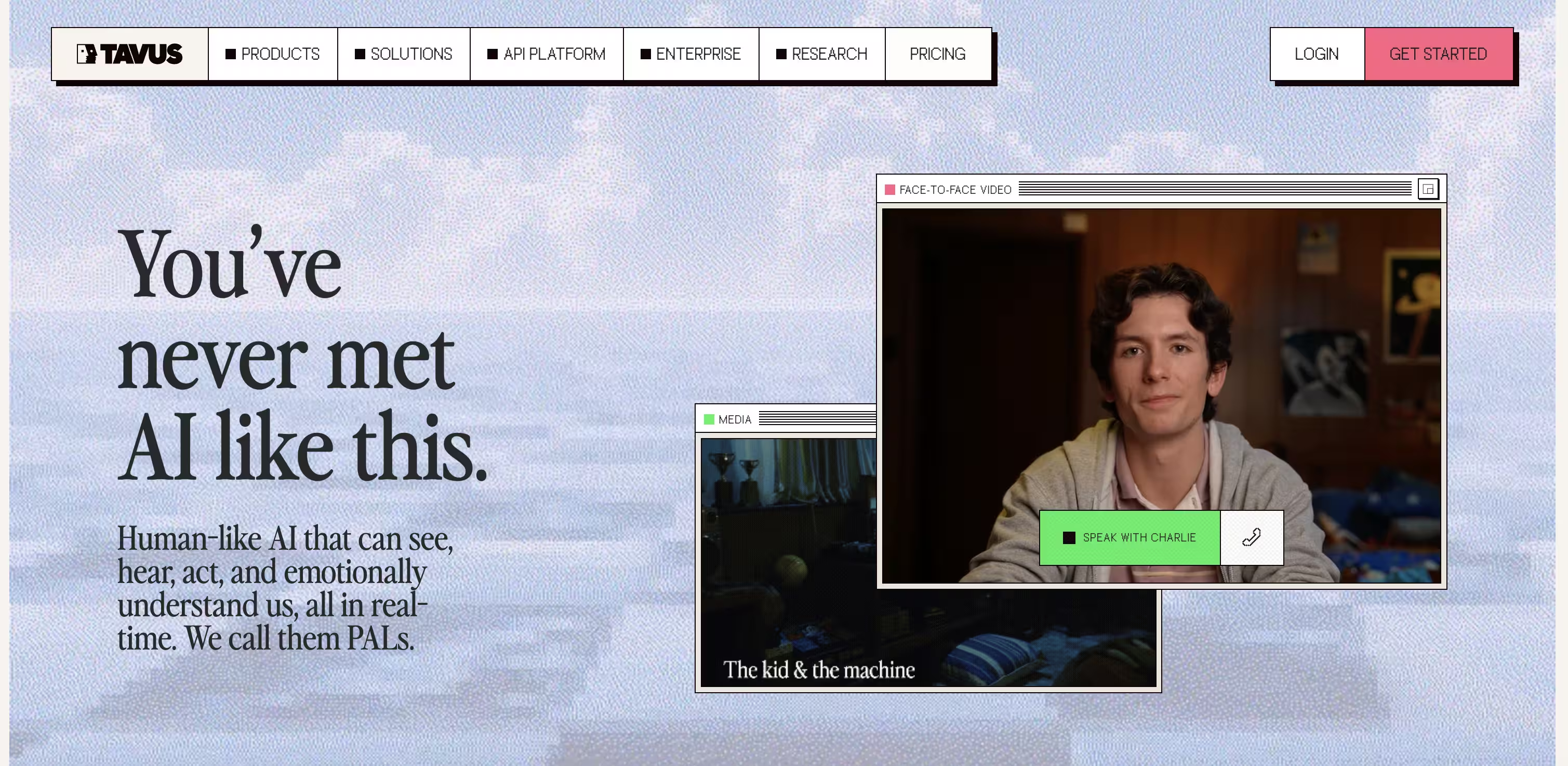
If the reason you're looking around is control — you want to build the experience yourself rather than buy one off the shelf — Tavus deserves a serious look.
Based on publicly available information, Tavus is a developer-first platform for real-time AI video. It offers a Conversational Video Interface (live, two-way AI humans) and video generation (script-to-video), with white-labeled APIs, bring-your-own LLM and voice, and low latency. And its rendering tech is genuinely impressive: Tavus's Phoenix model — now Phoenix-4, launched in February 2026 — uses a Gaussian-diffusion architecture to produce photorealistic, emotionally responsive digital humans in real time (Tavus, 2026). If raw photorealism is your yardstick, Tavus is at the frontier.
That's the appeal, and the catch. A toolkit is powerful, but it front-loads the work onto you: scoping the use case, wiring the orchestration, designing the experience, and maintaining it. For a training team without engineers, that's a lot. And there's a philosophical fork worth naming: Tavus renders photorealistic replicas of real people, while UneeQ crafts bespoke CGI characters you own and fully control. Different tools, different jobs.
Choose Tavus if you have a dev team that wants to build and manage a custom, photoreal conversational-video experience, and a turnkey training product isn't what you're after.
We went deeper on Tavus — and how it compares with the AI video generators — in our top Tavus alternatives guide.

If what you really want is to help people sound better on the phone (clearer, more confident, fewer "ums") Yoodli is a genuinely good, affordable tool, and a slightly different animal from Virti.
Yoodli started as an AI speech-coaching platform and has since expanded toward sales roleplay. It's strongest at the delivery layer: real-time, private feedback on pacing, clarity, and speaking style, plus progress tracking over time. It's SOC 2 Type 2 and GDPR compliant, integrates with common LMS and CRM tools, and is suitable for large and small teams. One caveat we found in our research around Yoodli pricing is that many auto-generated articles will tell you pricing starts at $8 per user. That's actually for the individual plan. So if you're an L&D team looking for Yoodli pricing, you'll need to inquire about their business and enterprise plans, which, according to Yoodli's website, have custom pricing.
Where it stops short of an immersive training platform: Yoodli is voice-first and communication-focused, so it's lighter on deep, face-to-face scenario roleplay. It's brilliant for polishing a presentation or an interview answer. It's less suited to rehearsing an emotionally complex, in-person conversation with a reactive, on-screen counterpart.
Choose Yoodli if your goal is individual speaking and presentation coaching rather than enterprise-scale, face-to-face practice.
If communication coaching is your lane, our top Yoodli alternatives guide breaks down that corner of the market in detail.
| Feature | Virti | UneeQ | Tavus | Yoodli |
|---|---|---|---|---|
| Primary mode | AI roleplay + immersive video | Face-to-face AI roleplay with digital humans | Real-time conversational video (developer API) | AI speech & communication coaching |
| How it renders the “human” | 2D CGI + generative video (partner facial animation) | Bespoke CGI digital humans (Synanim™) — not deepfake | Diffusion-model photoreal replicas (Phoenix-4) | Voice-first — no face-to-face avatar |
| Face-to-face realism | Moderate; varies by avatar | Very high — purpose-built | Very high — photorealistic | N/A — voice only |
| Built-in training use cases | Broad; hard + soft skills, healthcare roots | Sales, customer service, leadership, education | None pre-built — you build them | Speaking, presentations, sales roleplay |
| Soft-skills analytics depth | Behavior, decision & sentiment data | Deep — 3D Analytics | Whatever you build | Delivery metrics (pacing, clarity, filler words) |
| Enterprise deployment (on-prem / BYO-LLM) | Cloud; limited model choice | On-prem or private cloud; LLM-agnostic (BYO) | Cloud API; BYO LLM & voice | Cloud SaaS |
| Security | ISO 9001 & 27001, GDPR | SOC 2, GDPR | SOC 2, GDPR (per Tavus) | SOC 2 Type 2, GDPR |
| VR support | Yes — desktop, mobile & VR | No — web-based | No — web / video | No — web / mobile |
| Setup speed | Fast — no-code, minutes | Fast — minutes; bespoke builds longer | Developer build required | Fast — minutes |
| Pricing model | ~$399–$1,199/mo + custom enterprise | Custom enterprise (platform + per-user) | Business $975/mo + pay-as-you-go overage; custom enterprise | Custom for teams & enterprise (individual from ~$8/user/mo) |
| Best for | Broad coverage incl. VR, at an accessible entry price | High-fidelity, measurable face-to-face roleplay at enterprise scale | Dev teams building custom conversational video | Individuals improving how they speak |
Based on publicly available information, 2026. Confirm current specs and pricing with each vendor.
This is the difference that decides most L&D decisions — how realistic are the interactions. So it's worth thirty seconds to unpack. All four tools put some kind of "human" in front of the learner, and there are lots of names for this, from digital human to virtual human, video avatar and more. Each Virti alternative builds that human in very different ways:
Match that to your job. If you need to train staff for in-person conversations or simple phone calls, the platform you need likely changes. One top tip when looking for a training solution, fidelity matters more than you might first realize. So aim for an experience staff can ultimately immersive themselves in, suspending disbelief, for the most effective AI roleplay training — and fewer private messages about people being creeped out by the technology.
Here's the short version:
Match the tool to the training job, and you'll spend your budget on the outcome you actually care about.
What reviewers like (G2): ease of use is the clear standout at 12 mentions, followed by interactive content and product growth (5 each), then content quality and collaboration (4 each). Common gripes: audio issues lead at 5 mentions, with slow performance, missing features, a learning curve, and difficult setup each raised by a couple of reviewers (G2, 2026). Read strategically, that's an easy-to-adopt, well-liked platform whose rough edges — audio quality and avatar realism especially — matter most when your training depends on realistic, high-fidelity conversations.
Usually for one of three reasons: they need higher-fidelity, face-to-face realism for sensitive conversations; they want deeper data on how people's soft skills are improving; or they have enterprise requirements like SOC 2, on-premise, or bring-your-own-LLM deployment. Just as often, teams stay put — if you want broad coverage, VR, and a low entry price, Virti may already be the right fit.
It depends on how real the practice needs to feel. For emotionally charged, face-to-face conversations — a frustrated customer, a tough performance review — fidelity matters, and higher-realism digital human platforms like UneeQ are built for it. For procedural or hands-on skills, or where VR immersion helps, Virti is a strong choice. Voice-only tools like Yoodli suit spoken delivery rather than reactive, in-person scenarios.
They differ, so look closely. Virti reports on behavior, decisions, and sentiment within scenarios. Yoodli focuses on delivery metrics like pacing, clarity, and filler words. UneeQ's 3D Analytics scores the harder-to-measure human parts of a conversation, like empathy and connection. If proving soft-skills ROI is a priority, compare how deep each platform's analytics genuinely go.
No. Virti supports VR headsets but also runs on desktop and mobile, and many customers never use VR. UneeQ, Tavus, and Yoodli are web-based, with no headset required. Choose VR only if immersion in physical or procedural tasks genuinely adds value — for most conversation-based training, a headset-free rollout is simpler and cheaper.
Check this early, because it varies by vendor. Virti holds ISO 9001 and ISO 27001 and is GDPR compliant. If your requirements include SOC 2, on-premise or private-cloud hosting, or bringing your own LLM, confirm each vendor directly — UneeQ, for instance, is built enterprise-first with SOC 2, GDPR, on-premise options, and LLM-agnostic architecture. Tavus and Yoodli also cite SOC 2; verify current specifics.
Virti publishes pricing from around $399/month up to roughly $1,199/month, with custom enterprise quotes. Yoodli has a free tier and individual plans from about $8/user/month, with custom pricing for teams and enterprise. Tavus's business tier starts around $975/month plus usage overage, with custom enterprise. UneeQ is custom enterprise pricing. Always confirm current pricing directly (2026).
Match the tool to the job. Choose Virti for broad coverage across hard and soft skills, VR, and an accessible entry price. Choose UneeQ for high-fidelity, measurable face-to-face roleplay at enterprise scale. Choose Tavus if your developers want to build a custom conversational-video experience. Choose Yoodli to coach individuals on speaking and presentation skills.