.png)


Training






Services








Great leaders are great learners. And, whats more, that pays off for everyone. Here's how immersive learning is making incredible leaders.
.png)
Every February, around Valentine’s Day, we're encouraged to show love to the people around us. Cards, flowers, grand gestures, and smaller sentiments — it's a whole month dedicated to celebrating others.
But what we rarely talk about is developing a love of something that can transform your leadership career: learning.
Some leaders pour everything into their teams, their targets, their organizations. Others prioritize transformation around them. But the great ones? They fall in love with getting better.
My own goal over the past few years as COO at UneeQ is to become a better leader by becoming a better learner. Committing to learning is transformative — it's an investment in yourself that will genuinely elevate your leadership and create lasting impact on your organization.
Leaders are learners. Some of history's greatest have said as much.
John F. Kennedy, for instance, wrote in 1963 how "leadership and learning are indispensable to each other."
He was articulating a fundamental principle of effective leadership: that the moment we stop learning, we stop striving to be better leaders.
Putting this into the context of 2026, any exec will have their own personal anecdotes around how quickly things change for them and the organizations under their stewardship.
Companies pivot, tastes change, customer expectations shift, younger employees value different things, and our understanding of how to lead (what made us successful yesterday) can quickly become obsolete tomorrow.
Great leaders learn and grow, so they can be their most effective selves, for the benefit of everyone.
Simon Sinek captured the essence of this perfectly in his book Leaders Eat Last.
"If your actions inspire others to dream more, learn more, do more and become more, you are a leader."
Notice what's at the heart of that definition — learning. Great leaders don't just learn; they create environments where learning becomes contagious. They nurture curiosity. They ask questions instead of always having answers. They acknowledge what they don't know and seek to understand.
Sinek also says: "Great leaders are students of leadership." A quote I love, and which sums up the mindset and humility of any great leader.

So how do you actually become a better learner as a leader? Here are some approaches I've found valuable:
Embrace deliberate practice. Leadership skills (whether it's giving difficult feedback, coaching team members through challenges, or navigating complex negotiations) improve through intentional repetition and reflection. Seek out opportunities to practice leadership skills in low-stakes environments before the high-stakes moments arrive.
Create feedback loops. Actively seek honest feedback from your team, colleagues, and leader.
Learn in context. Research consistently shows that learning is most effective when it's immediately applicable. Rather than abstract theory, look for development opportunities that let you apply new skills to real challenges you're facing right now.
Model vulnerability. When your team sees you openly learning (asking questions, admitting mistakes, seeking input) you give them permission to do the same. This creates a culture where growth isn't just encouraged, it's expected.
Learning to be a leader isn't easy. I've previously stated that the 'soft skills' needed to be a great leader are actually hard to develop. But not impossible.
Leadership is a coachable skill, and should be treated as such.
Research from the Center for Creative Leadership reveals that nearly 60% of first-time managers receive no training whatsoever when they transition into leadership roles. It might come as no surprise that a very similar proportion (50%) of managers get rated as ineffective leaders.
It's not enough for leaders to have the curiosity, the drive, and the motivation to constantly learn; they need structure and support to make them the best leaders they can be.
Because everyone benefits from that — from the C-suite to employees and eventually customers. I struggle to think of any better competitive advantage an organization can give itself in 2026 than developing their leaders.
Which is why, before this Valentine’s Day, I'd ask you: are you busy showing love to everyone else while postponing investing in yourself?
Amid all the gestures for others, I'd encourage you to start one for yourself: develop a love of learning. And what better time to start?
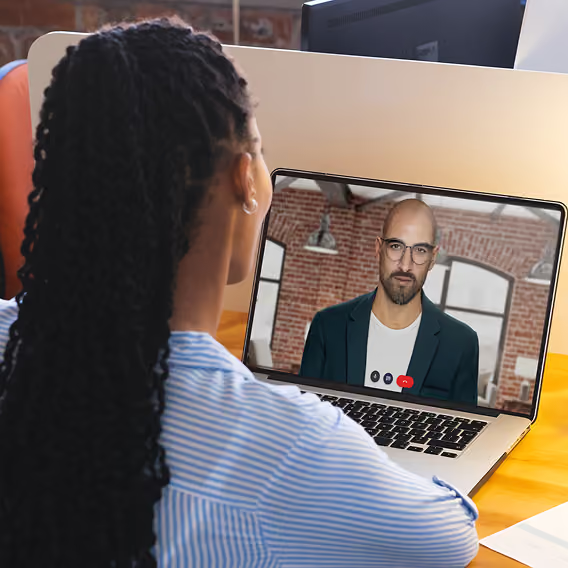
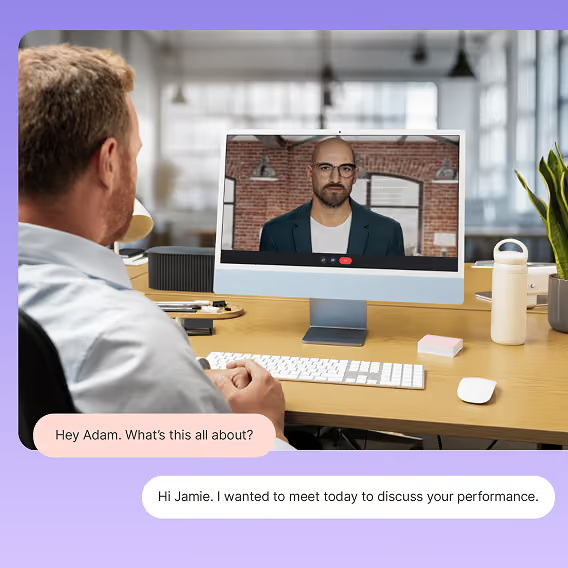
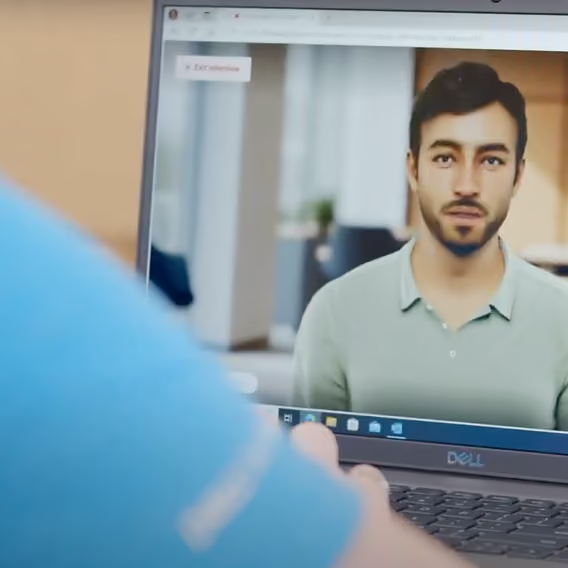
I've been using UneeQ's Immersive Training Platform to do just that — roleplaying leadership conversations to sharpen soft skills like clarity of communication and empathy.
If you're looking to do the same, our team would be happy to show you more and let you try it for yourself.
As JFK reminded us more than 60 years ago, leadership and learning aren't just connected — they're indispensable to each other.
The leaders who will thrive in the years ahead won't be those with all the answers. They'll be those with the humility to keep asking questions — and the courage to grow from what they discover.