
.png)




Training











Services









Employees forget up to 90% of training within a month. See why knowledge retention fails, what it costs, and how immersive learning makes skills stick.
.png)
Most workplace training is forgotten fast. Research on the forgetting curve shows people lose around half of new information within an hour and up to 90% within a month — which means much of the $102.8 billion US companies spent on training in 2025 quickly and unceremoniously evaporated. Fortunately, L&D teams are finding that the fix is reinforcement: repeated, active practice.
Blame a 140-year-old discovery. In 1885, psychologist Hermann Ebbinghaus mapped the "forgetting curve" and found that humans lose newly learned information at a predictable, brutal rate — roughly half within an hour, and the vast majority within a month. His findings were replicated and published in PLOS ONE in 2015, so this is not folklore, nor a L&D trend that will pass; it's a sticky problem that's effected learning for over a century.
Yet most corporate training still runs as a one-and-done event. Employees sit through a workshop, click through an e-learning module, pass a quiz, and then get nothing. There's no structured way to keep practicing. And without reinforcement, the curve wins every time.
It shows in the numbers: a large chunk of training isn't even finished, and another big chunk is instantly forgotten.
The result is a slow leak that drains value out of nearly every L&D program at enormous scale. How much exactly? This is where L&D teams start to get concerned.
A lot. US organizations spent $102.8 billion on employee training in 2025, according to Training magazine's annual Industry Report. Now apply the forgetting curve to that figure. If up to 90% of what's taught is gone within a month, the value of the vast majority of that spend fades out almost as fast as it's booked. So somewhere in the order of $90 billion in training value evaporating, year after year.
But the dollar figure is only half the story. The bigger loss is human potential:
The real cost is hard to quantify on an individual company. Because it's not just wasted training investment, but the cost of a lost opportunity to make the workforce better.
Unprepared salespeople burning real pipeline; service reps fumbling and churning difficult customers; new managers alienating their employees; avoidable mistakes made that materially impact the organization — it all results from training that doesn't stick.
Because traditional training is built as a single event, when it needs to be a continuous resource. The forgetting curve has a well-known cure — structured reinforcement, repetition and active recall — but you can't deliver reinforcement with a single workshop on a single afternoon.
A few reasons today's training falls flat:
Put simply: knowledge fades, practice gets skipped, ROI isn't met, and no one looks good.
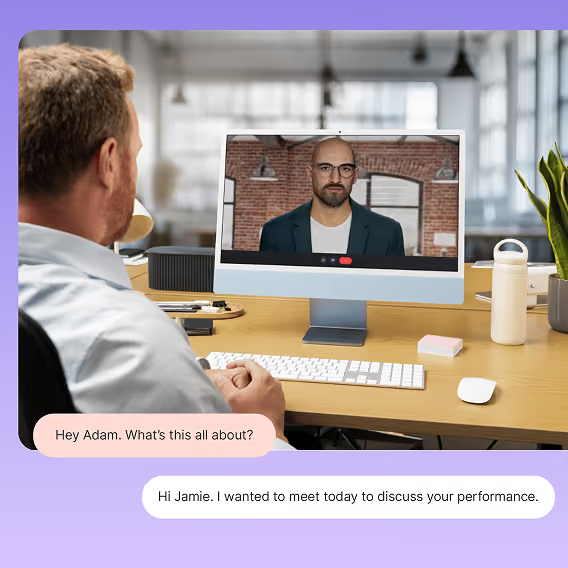
Immersive learning is an approach that puts people inside realistic, interactive scenarios where they actively participate instead of passively consuming content. But don't think 'immersive' means collecting VR headsets that take up your entire budget and heaps of closet space; the most advanced immersive learning options today run in any web browser, yet create the feeling of being in a realistic training scenario — for instance, a sales call, a customer service conversation, or a Zoom meeting with an employee.
Here's how immersive learning solves the retention problem the way traditional L&D never could:
Check out an example of immersive learning below in our sales training overview video.
The data says yes. At UneeQ, our clients have seen increases in their learning and development metrics that include:
For example, Pearson, one of the world's leading educational providers, uses UneeQ's platform to power language learning, training staff across 60 workplace-specific scenarios with 1,800 roleplay variations — accessible to everyone 24/7 so staff can constantly reinforce what they've learned.
This only scratches the surface. If you're looking to improve the retention of your staff training, our free guide, The 90% Problem: Why Traditional Training Fails — and How Immersive Learning Fixes It, digs into the science of retention, the real cost opportunity, and a practical checklist for choosing an immersive learning solution.
Download The 90% Problem eBook here.
.png)