
.png)



Training









Services









Your hype-free guide to the five ways employee training simply HAS to change in 2026, for the good of L&D teams everywhere.
%20(1).png)
We tend to overestimate the effect of a technology in the short run and underestimate the effect in the long run. Just think of the incredible cartoon series, The Jetsons, which first aired in the 1960s.
Set 100 years in the future, The Jetsons painted a picture of a futuristic utopia, filled with effortlessly flying cars, cities above the clouds, and the ability to choose your own dreams.
It also featured tech we consider part of our everyday lives today, even though it felt like a leap of imagination 60 years ago — from the ‘handheld encyclopedia’ that pre-dated the smartphone to video call phonebooths.
Amara's Law is what we call this phenomenon of underestimating what the distant future holds while overestimating the coming months and years. Which brings us neatly onto our predictions for learning and development in 2026.
How much change can a year really bring?
Well, while employee training is likely to look very similar by the end of the year as it does today, there are some changes the industry needs to make, and some trends that will begin to shape the future of L&D as we know it.
Let’s look at the top five (we’ve saved what we think is the best for last).
Employers spent a whopping $103 billion a year on training in 2025, and yet research shows only 27% of learning and development budgets historically go toward improving people's soft skills.
And it's starting to show.
Only 12% of mid-level executives believe that entry-level Gen Z applicants are ready for today's workplaces, and the top reason they give is a lack of soft skills.
In fact, almost half of execs (49%) say young candidates are struggling to land jobs because of their soft skills, with communication, collaboration and adaptability the most commonly cited complaints.
The kicker is that Gen Z agrees. Some 40% claim their biggest weakness is soft skills. And both Gen Z and Millennials agree these skills are just as, if not more, important than technical abilities for career advancement.
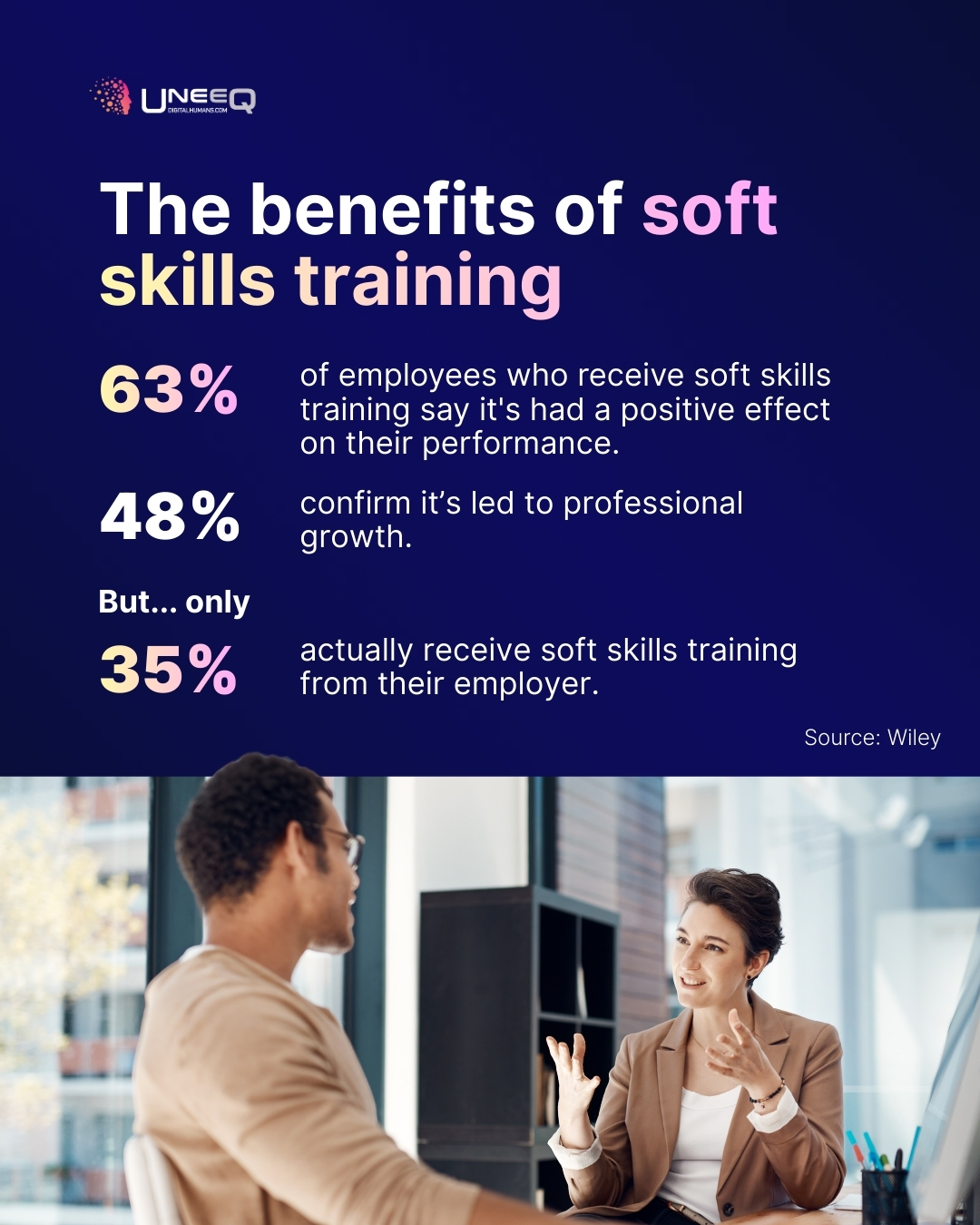
As Emma Lavelle says when discussing what are the best soft skills in leadership, ‘soft’ doesn’t mean ‘easy’. They’re actually really hard to train, and certainly aren’t something people are born with. It often leaves crucial skills under-developed, from the C-Suite to customer-facing roles.
The under-investment in soft skill training is having a material impact. Which is why 2026 has to be the year it gets the investment it deserves — and there are already signs of that happening.
After the pandemic, the biggest area of focus for organizations reskilling their workforce was interpersonal skills and empathy, according to McKinsey & Co.
Fast-forward to today, and roughly a quarter of employers believe soft skills will be more important than technical ones in 2026 — just 14% said hard skills are more valuable.
None of this should come as a huge surprise. As workplaces become more digital, more distributed and more automated, the human parts of work matter more, not less.
Workplace silos have long been the bane of any organization. People’s skills and capabilities don’t always align with the roles they’re in.
Having roles with rigidly pre-defined responsibilities and expectations hardly screams flexibility and innovation.
As a result, organizations are increasingly moving towards a skills-based model of work, where roles are thought of as a collection of essential capabilities rather than just a job title. People can flow from one project to the next, with work structured around who is best-suited to tackle particular problems rather than being based solely on seniority or roles.
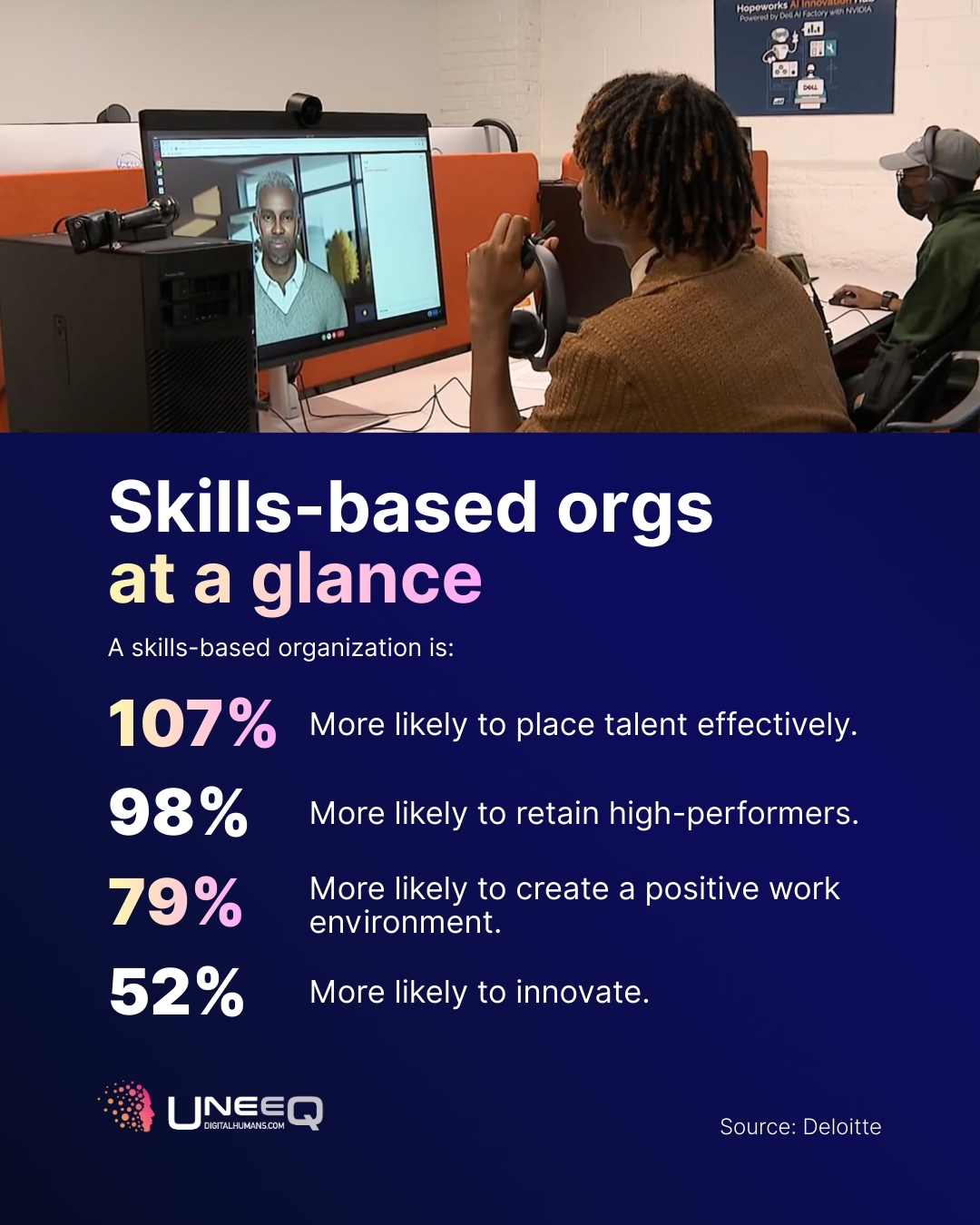
Training that is tightly bound to roles is therefore beginning to feel restrictive, struggling to keep up with the way that work is now done.
And employees feel it too. They're either sitting through content that isn't relevant to their day-to-day job, or missing out on the skills they actually need because they're not 'in scope' for their current title.
L&D clearly has a huge role to play in the transition. And in 2026, we expect to see far more organizations with a 'skills-first' mindset, and a training approach to match.
This type of training often incorporates immersive learning, which focuses on teaching people practical skills in lifelike scenarios. These environments allow people to practice over and over again until they've perfected them — realistic learning, with real results. But I’m jumping ahead…
Remember Amara's Law? Well, one of the reasons why we underestimate how much things will change in the long-term is because we, as humans, are really quite terrible at predicting exponential growth. We tend to think of change as a linear progression.
AI is certainly an example of exponential change. And if you think 2026 will see linear growth in AI adoption for L&D departments, you may very well be experiencing Amara’s Law in practice.
So, okay, this may not be the boldest prediction on this list, but 2026 is likely to be the year when AI experimentation in the training department goes beyond experimentation — where L&D teams move from dabbling to delivering.
Currently, 71% of L&D professionals are exploring or integrating AI into their work, according to LinkedIn. Tools powered by large language models (LLMs) and conversational AI are commonly used for drafting and adapting learning content, performing skills gap analysis, personalizing learning paths, and much more.
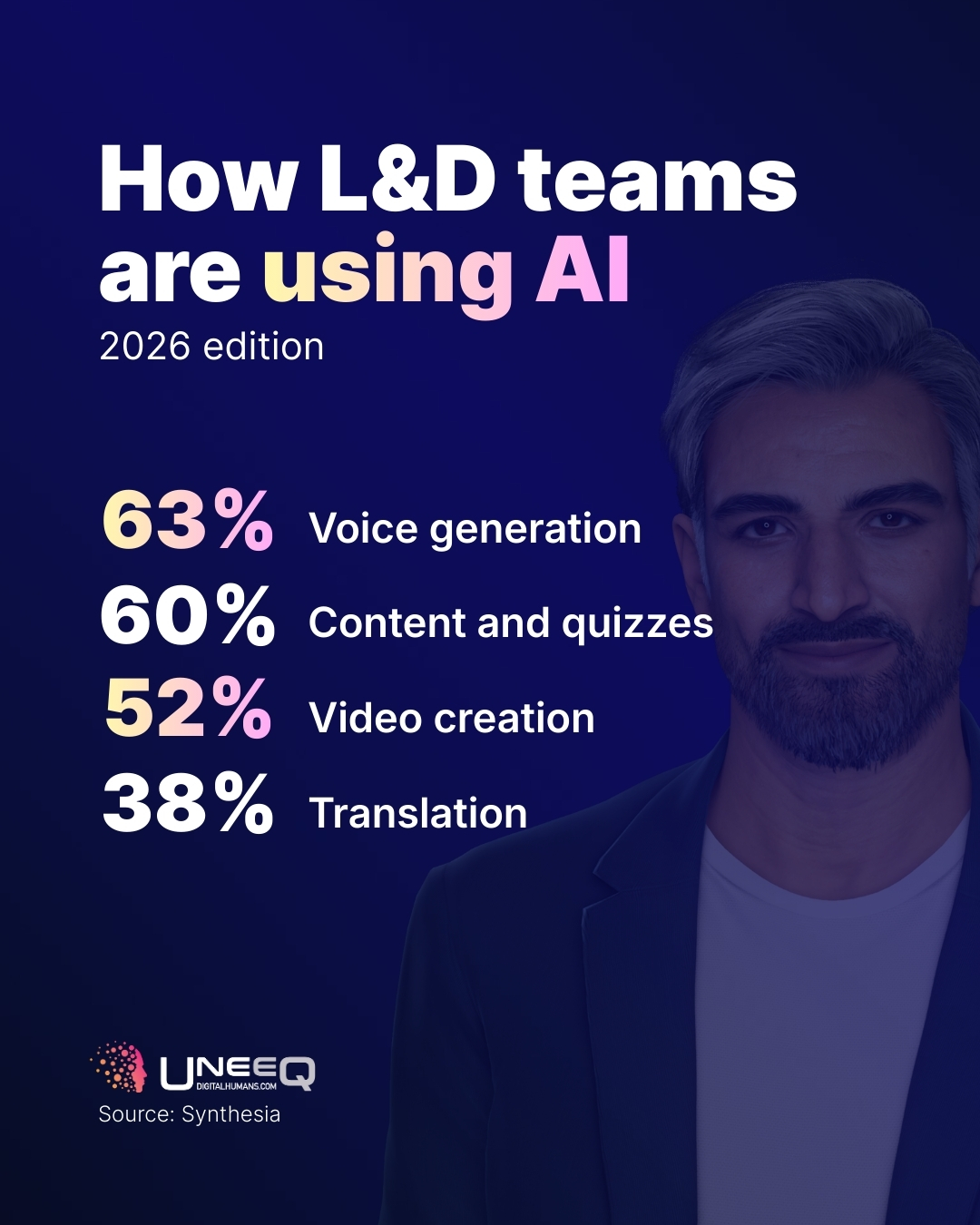
This is a game-changer for many overstretched L&D departments. A small team can now operate at a scale that would normally require more people and far bigger budgets.
L&D teams can shift from being full-time content factories into learning architects and strategists. That is, people who deeply understand organizational performance issues and can design the learning experiences that actually solve them.
But let's not forget about the learners themselves. At the moment, just 2% of training hours are delivered through AI, but chances are, this will be much higher this year as employers get to grips with the tools that can take staff training to the next level.
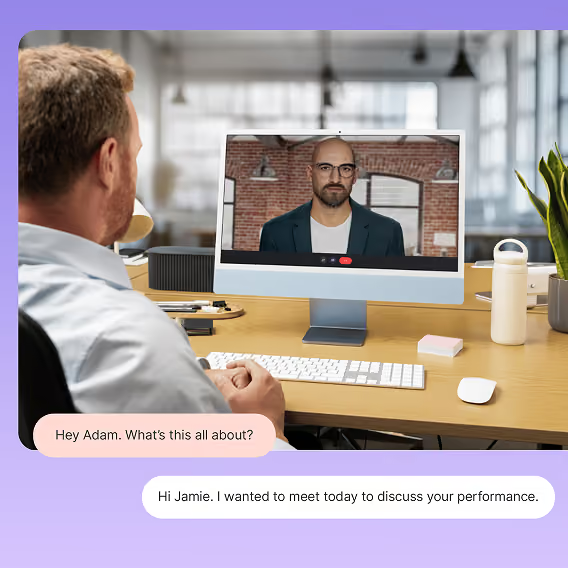
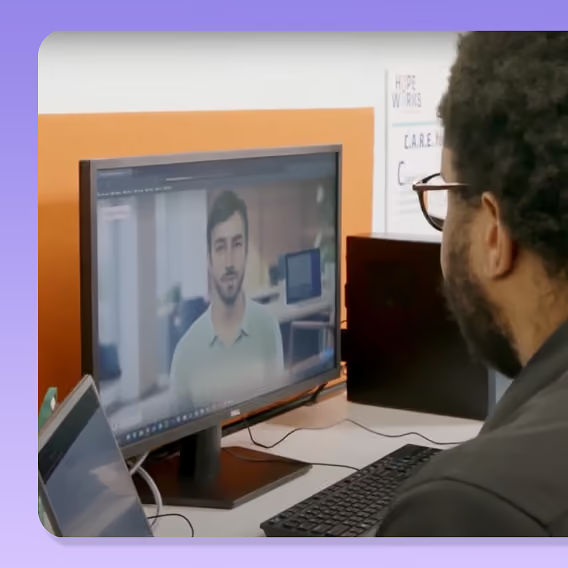
Take AI-powered digital humans, for example. They allow learners to practice persona-based conversation-based training scenarios in psychologically safe environments where feedback is instant and data on each interaction is recorded.
Our research shows that this enables people to get up to speed faster, retain more of what they learn, and build confidence before encountering high-stakes make-or-break situations on the job.
However, L&D teams move forward with AI, the opportunity is there to make learning more practical, more human, and better aligned with the objectives of both organizations and employees.
Many of us have undergone training that was more sizzle than steak. Flashy on the surface, but lacking any real substance. Done because that’s the way it’s always been done.
The big problem with this type of 'training theater' is there's no guarantee it works. In learning research, this is known as 'transfer of training' — whether what people practice in training carries through to the job.
The worst example is arguably roleplay in sales training — where reps awkwardly practice their pitch with managers or other peers to get direct feedback.
These reps aren’t assessed on their sales skills; they’re assessed on their performance presenting to their manager.
As Andrew Quinn, former VP Sales Enablement and Productivity at HubSpot told us: “in sales, practice equals roleplay. And (let’s get real here) most sales managers suck at roleplay.”
Everyone hates it, and yet it remains on the calendars of every rep and every sales manager. Why? Because organizations are trapped in the training theater.

A good way for L&D teams to get off the stage and into the real-world is by looking at what success looks like in the training they offer.
For a long time, L&D has gauged progress with completion rates, attendance, and smile-sheet scores. The trouble is that these metrics mostly prove one thing: people sat through (or clicked through) the content.
Many such metrics don’t demonstrate whether trainees are better at their jobs afterwards.
In fact, only 16% of employers assess behavioral change among employees after training to see if it's been successful, with 28% instead judging purely on satisfaction levels. Nearly a third (30%) don't evaluate their employee training at all.
As L&D budgets tighten and scrutiny increases, this approach will get harder to defend in 2026. Which is why we expect to see the focus shift to metrics that more accurately measure the success of training programs.
Are people actually using learning platforms and tools? Are they improving on what the training was meant to improve, like customer outcomes, error reduction, quality scores, or sales readiness? Are new hires onboarding faster, and are role transitions less painful?
These are some of the questions that matter because they speak the language of the business and show that training is not only engaging, but effective.
AI-powered training is well suited to this because it generates performance data as people practice, and it's this data that shows whether or not what you're doing is working.
For example, users of our Immersive Training Platform report onboarding efficiency is 16x higher for new employees than standard training, with 40% of learners reporting improvement in their confidence.
With the adoption of AI (see our third prediction), it really could be time for theater training to leave the stage.
Until recently, the phrase 'immersive learning' was almost synonymous with virtual reality (VR). If there was no headset involved, it somehow didn't count.
In 2026, that thinking is likely to change. Because when you look at why VR never really took off in employee training, you begin to see another way forward.
VR had a genuine moment of excitement, and in specific settings it still makes sense. But for most organisations, this VR training comes with a long list of downsides: expensive hardware that goes out of date quickly, content that’s slow to build and unusable across other channels, constant updates and maintenance headaches, and learners who feel more motion sick than immersed!
Many teams gave it a try, then quietly moved on.
How do we know? Well, 3% of all training hours were delivered through augmented reality (AR) and VR in 2024. By last year, that had slipped to less than 1%.
But what did the promise of VR training really provide? Immersion. Placing people in situations where they felt like they were working, not just training. A flight simulator for any role, and scenario within it.
Other technologies offer the same benefits, without the downsides.
Conversational AI now delivers interactions that employees encounter every day, and which define their roles. Those encounters can be almost anything: rehearsing difficult conversations with unhappy customers, practicing a sales pitch, giving performance reviews as a leader, training nurses in their bedside manner, or improving public-speaking.
That kind of experience doesn't require a headset — it can be entirely screen-based.
Platforms like UneeQ's Immersive Training Platform show what this looks like in practice. Because the interactions are conversational and adaptive, learners can participate in sophisticated AI roleplay without needing special equipment or a spare half-day to attend a training session.
Crucially, truly immersive learning works for the kinds of skills most organisations care about right now: communication, judgement, confidence, empathy, and consistency. It's easier to create content, faster to scale, and works on any browser — no headsets or IT skills needed.
As with any 2026 predictions article, there’s a lot of speculation. The future is unknown, but it’s being written today.
If you agree that employee training can become much more effective, productive, and immersive, I hope you take a look at what we’re doing here at UneeQ.
We know from talking with clients that L&D professionals are looking for positive change in the months and years ahead. The industry isn’t resting on its laurels, with innovation high on the agenda.
If you’d like to make learning and development your competitive advantage in 2026, we’d be happy to show you how it works.