
.png)




Training









Services









What's the ROI of a digital human? See how Emma saved Amarillo a projected $1.8M in year one, plus a four-part framework to measure your own returns.

The ROI of a digital human is the value it creates — costs avoided, staff capacity reclaimed, audiences reached, and trust earned — measured against what it costs to run. The City of Amarillo's digital human, Emma, shows the math in action: she answers around 16,000 resident questions a month, has delivered a projected $1.8 million in annual savings, and holds approval ratings between 90% and 98%. To measure digital human ROI, track four returns: the cost you avoid, the capacity you reclaim, the reach you unlock, and the trust you earn.
Emma works around the clock. She speaks fluent Spanish, never takes a lunch break, and saved her employer a projected $1.8 million in her first year on the job. Her approval ratings have run as high as 98% — the kind of number most of us would frame and hang above our desks.
She's also, technically, not a person.
Emma is a digital human built for the City of Amarillo, Texas, by Dell Technologies and UneeQ. And she might be the clearest answer yet to the question every CFO asks when a digital human project lands on their desk: okay, but what's the return?
Let's answer that properly, with real numbers, a real live case study, and a framework you can take away.
Digital human ROI is the measurable business value a digital human generates, compared to the total cost of building and running it. The formula is the one you already know: (annual value created − annual cost) ÷ annual cost. The value side includes hard savings, like deflected support requests, plus compounding returns like language access, 24/7 availability, and customer satisfaction.
If you're looking at digital humans for immersive training, you'll be looking at metrics such as ramp time, time to proficiency, CSAT, etc. Regardless, the equation remains the same: (annual value created − annual cost) ÷ annual cost.
Let's look at this through the use case of a digital human customer-facing assistant.
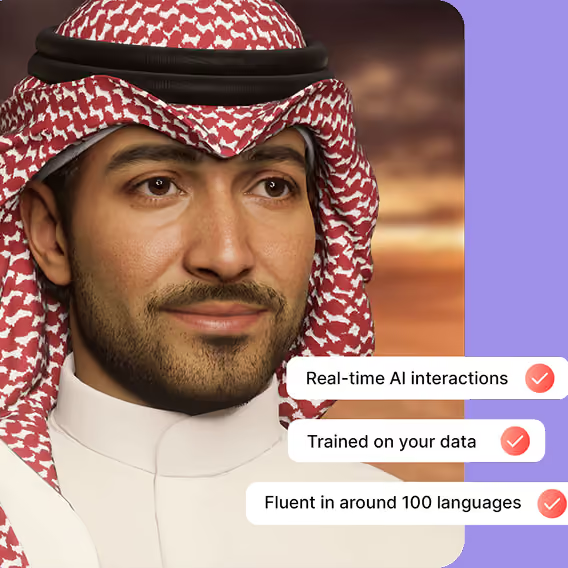
What makes the math different from other automation organizations might buy is the "human" part. A digital human pairs conversational AI with a lifelike face, voice, and emotional expression. That combination takes on work that used to need a person, while delivering an experience people genuinely like using.
Both halves show up in the ROI, as one Texas city proved.
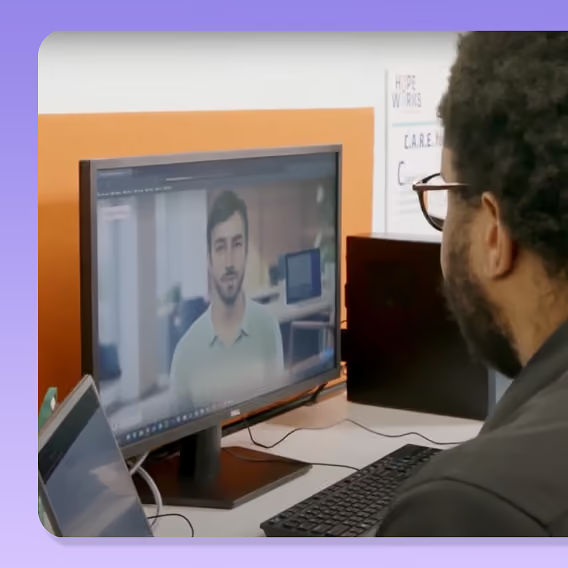
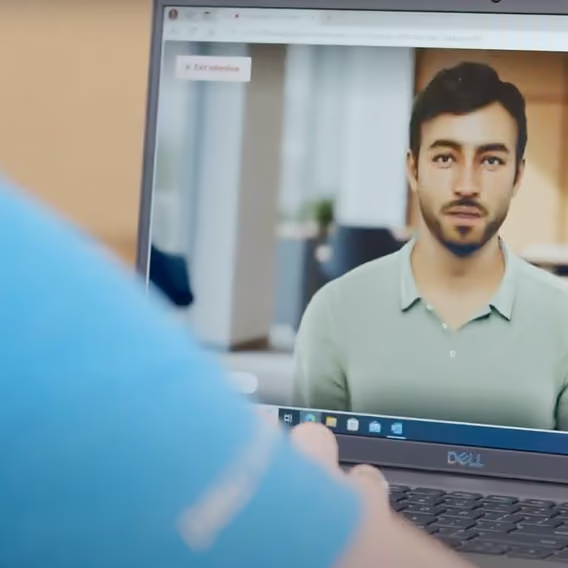
Emma is the City of Amarillo's digital human assistant, launched in December 2024 and built with Dell Technologies on UneeQ's digital human technology. Within a year, she was answering around 16,000 resident questions a month — roughly half the city's total inquiry volume — allowing Amarillo to defer a $1.8 million investment in new call center hires.
Here's the situation Amarillo faced. The city of 200,000-plus fields about 32,000 questions a month through its call center. Its residents speak as many as 62 languages, and around 24% don't speak English. That's a real barrier when city services — paying a water bill, booking a park, using the library — mostly live behind an English-language website and a phone queue.
So the city gave residents someone to talk to. Emma launched in English and Spanish, built to scale to many more languages over time, and available any hour a resident happens to need her.
The results, twelve-ish months in:
And the returns aren't only financial. "Our approach is to be a conversational city," Assistant City Manager and CIO Rich Gagnon told Route Fifty — framing Emma as a way to rebuild trust between residents and their government, one conversation at a time.
Measure digital human ROI across four layers: the cost you avoid, the capacity you reclaim, the reach you unlock, and the trust you earn. The first two are hard savings you can drop straight into a spreadsheet. The last two compound over time — and they're usually the reason the project gets renewed.
This is the CFO's favorite layer: contacts your digital human resolves that would otherwise cost staff time, plus hiring you no longer need.
Metric to track: containment rate (conversations resolved without human escalation) multiplied by your cost per contact. Emma's version: half of Amarillo's monthly question volume handled, and a $1.8 million call center expansion left unspent.
Every routine question your digital human absorbs is time your team gets back for work that actually needs a human.
Metric to track: staff hours redirected, and what happens to complex-case resolution once people have room to breathe. Emma's version: Amarillo's agents now focus on the tricky, high-stakes resident cases instead of repeating office hours 400 times a day.
A digital human works at 3 a.m., speaks multiple languages, and never puts anyone on hold. That means serving people your current setup quietly excludes.
Metric to track: after-hours conversations, non-primary-language sessions, and first-time users. Emma's version: a front door to city services for the 24% of Amarillo residents who don't speak English.
Satisfaction, repeat usage, and brand (or civic) goodwill. Soft to name, easy to measure, and the layer that turns a pilot into a program.
Metric to track: approval or CSAT scores, sentiment, and returning users. Emma's version: approval between 90% and 98%, and a city willing to build its whole engagement philosophy around her.
To build a digital human ROI case, baseline your current contact volume and cost per contact, set a containment target, measure satisfaction from day one, and report against all four returns every quarter. In practice:
Digital human projects lose ROI when there's no baseline data, when the deployment is AI for the sake of AI, or when the digital human is treated as a launch-day gimmick instead of a team member with a job description and KPIs.
The most common leaks:
If you have a question about setting ROI objectives and hitting them, check out the FAQ below. Cant find an answer to your specific questions? Book a call with our team and we'll help.
For digital assistant use cases like Emma, it comes down to: the cost of your digital human project, how many conversations you handle, and what each one costs you. High-volume teams see payback fastest, because every contained conversation is money that stays in the budget. As a real-world marker, the City of Amarillo reported seven-figure savings within the first year of running its digital human, Emma. Check out our digital human ROI calculator above to run your own rough projections.
Use our handy digital human ROI calculator above to see roughly the return on investment you can expect. To better understand the cost of your digital human (including character creation and platform licences) book a call with the UneeQ team.
The math is identical; the ceiling isn't. UneeQ's research finds 89% of users prefer digital humans over chatbots, and digital human deployments have driven up to a 300% lift in engagement. That matters because engagement feeds straight into the numbers ROI is built from — containment, satisfaction, conversion. Worth remembering that a deflected-but-annoyed customer looks like a saving on the spreadsheet and a loss in the relationship.
Yes — the four returns map across neatly. With the Immersive Training Platform you avoid the cost of trainers, actors, and travel; reclaim the coaching hours managers currently spend one-to-one; unlock realistic practice for every employee at any hour; and earn measurable skill growth, with 3D Analytics putting hard data behind human skills like empathy and confidence.
Amarillo is itself a government deployment, so the short answer is yes. For regulated environments, check the foundations early rather than late: SOC 2 Type II certification, GDPR compliance, and flexible hosting including private cloud and on-premise — all part of UneeQ's digital human platform offering. Also worth confirming that your conversation data is never used to train models.